Last week, our very own Keith from Fluidic attended the 2024 Engineering and Technology Solutions Exhibition at EDF Energy’s Heysham Power Stations.
Supported by Nu-Tech Exhibitions + Events, the event brought together a wide range of industry professionals, suppliers, and technical specialists, creating a valuable platform for collaboration and knowledge sharing.
Throughout the day, we had the opportunity to engage in insightful conversations around current challenges and future developments within the energy sector, while also showcasing the innovative solutions and expertise Fluidic can offer. It was particularly rewarding to connect with both familiar faces and new contacts, strengthening relationships across the industry.
A big thank you to everyone who took the time to speak with us—we look forward to continuing these conversations and building on the connections made.
Senior Calibration & Service Engineer (Glasgow)-Colm Heneghan
Colm Heneghan joined Fluidic in July 2023, bringing over 20 years of experience from his previous role as After Sales Manager at a water treatment company. With an HND in Electrical Engineering, Colm has extensive knowledge of the electrical industry and strong expertise in service and after-sales support. He now provides calibration and service work at Fluidic, leveraging his technical background and excellent customer-facing experience.
Work is a Treat… No Tricks Here!
At Fluidic, we always enjoy bringing a bit of fun into the workplace, and Halloween is the perfect opportunity to do just that. Each year, we encourage our team to get involved, and once again, they didn’t disappoint!
From creative to spooky, it was fantastic to see the effort and enthusiasm that went into this year’s costumes. Moments like these are a great way to bring people together, boost team spirit, and celebrate the personalities that make our workplace so unique.
Here’s a look at some of the brilliant outfits from across the team—thank you to everyone who took part and helped make the day such a success.
Wishing everyone a very Happy Halloween! 🎃
COVID-19 Ventilation
As defined by the Health & Safety Executive (HSE) website, the law states that “employers must make sure there’s an adequate supply of fresh air (ventilation) in enclosed areas of the workplace”. Following the COVID-19 pandemic, this of course is now even more important. Adequate ventilation reduces how much virus is in the air. It helps reduce the risk from “aerosol” transmission. Aerosol transmission can happen when someone breathes in small particles in the air (aerosols) after a person with the virus has been in the same enclosed area.
The risk from aerosols is greater in areas that are poorly ventilated.
You can do this by using:
natural ventilation – fresh air comes in through open windows, doors or air vents. This is also known as ‘passive airflow’, or
(The above links will take you directly to the HSE website).
From either method above though, it is important to quantify the performance of your ventilation, be that natural or mechanical. An HSE recognised method is via CO2 detectors. Fluidic have a long history of supplying Vaisala CO2 detectors such as the GMW90 Series. This wall mountable detector also has options for RH&T monitoring to ensure your office is operating at the most comfortable and efficient conditions. A local display is accompanied by red/amber/green warning LEDs for quick visualisation of office conditions. A 4-20mA signal can also be brought back and incorporated into your office BMS system where appropriate.
Video by the HSE on Ventilation and the use of CO2 detectors
Along with the links above, see HERE for more information directly from the HSE website.
Within our own Glasgow office, we are currently using a GMW86P sensor, connected to our Hanwell EMS datalogging system. This gives real-time logging of current CO2 levels, with email alarm alerts should CO2 levels rise beyond an internally set threshold. This system gives 24/7 monitoring, so we can also measure CO2 levels when the office is unmanned, useful as a reference level vs a full office. A remote log in demonstration is available if you were interested in this system – please call the Glasgow office on 0141 641 5920 to arrange.
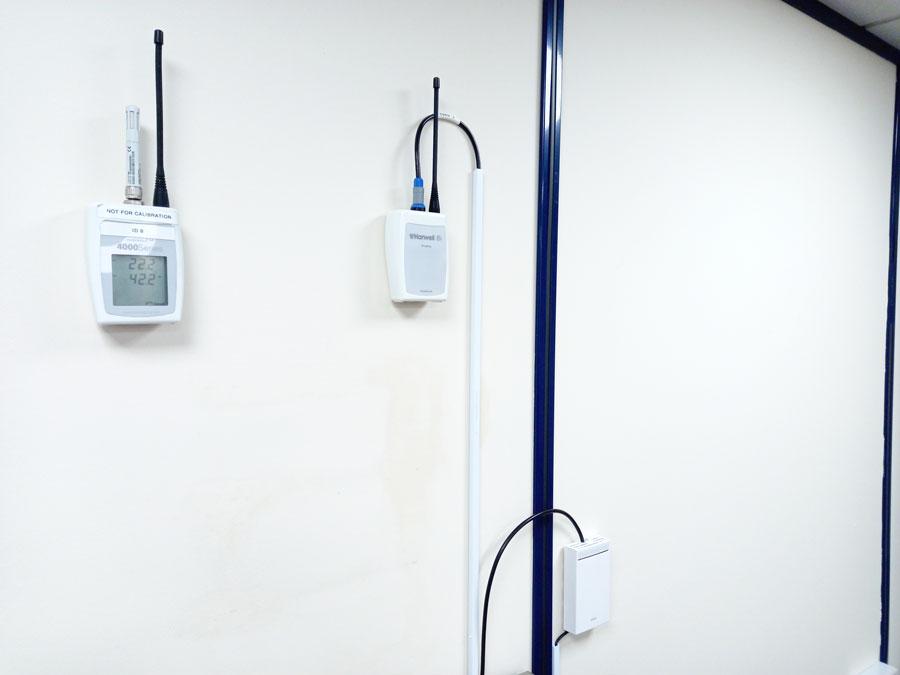
Some photos of our setup can be seen below:
The above shows the Vaisala GMW86P which provides a continuous 4-20mA output. The 4-20mA is collected by a Hanwell RL4809 and information updated to our Hanwell EMS system every 15 mins. Incidentally, to the left of the RL4809, note we have an RL4114 RH&T transmitter to monitor the general comfort levels for our team. This is a 3.6V AA battery powered device, with battery life expected <2years in normal service. Fluidic offer annual calibrations on most Hanwell transmitters and would generally change the battery as part of this.
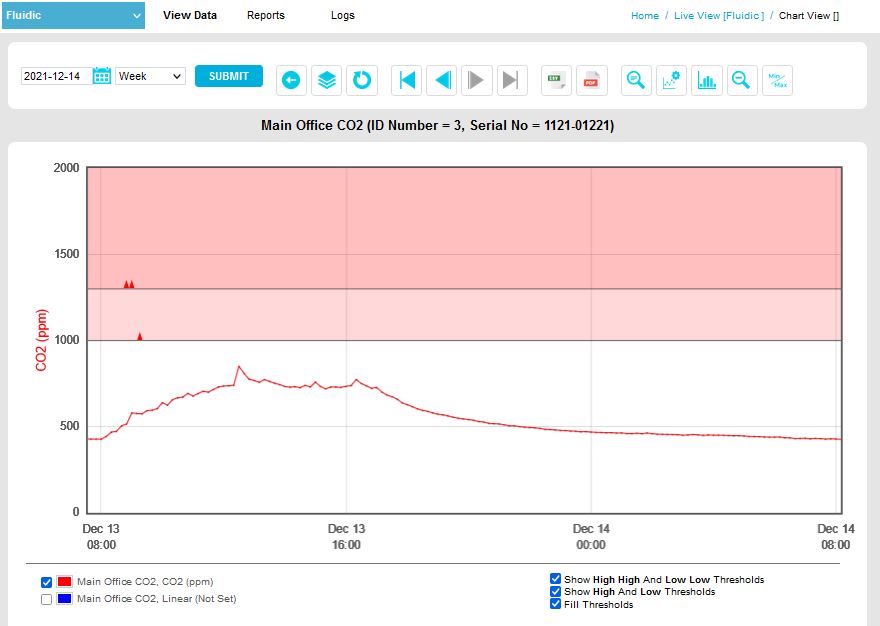
Above shows a screenshot of yesterday (noting this post was created 14/12/21). We have a high level alarm at 1,000ppm in line with ASHRAE typical standards and a High High alarm at 1300ppm – set as a failsafe for our own peace of mind. Although our office is showing CO2 levels well within these levels, it is interesting to note that there is a clear rise in CO2 levels as the team start to come in the office at about 8.30am, dropping again just after 5pm.
For help with any ventilation measurement application, please call either office – Glasgow (0141 641 5920) or Warrington (01925 572401).
Job Opening: Internal Sales Engineer, Glasgow
Fluidic are a progressive, instrumentation distributor with 2 UK locations. We are looking to strengthen our Glasgow office with an Internal Sales Engineer. Key responsibilities of the post will include:
Preparing quotations and handling customer enquiries via telephone and email.
Co-operation with suppliers to consider and prepare a technically competent and economically competitive solution for the customer
To maintain a register and history of customer interaction working with our CRM system, including quote follow ups
To keep customers updated with order status, delivery schedules, working with our order processing system
To work with supplier pricing structures, intranet systems etc.
The successful applicant will be a team player, not averse to helping out in other company areas as and when necessary.
As experience in the position grows more time may be allocated to pro-actively pursuing new customers, applications and markets
Applicants will have a technical background. A background with instrumentation or control being a distinct benefit but not necessarily a deal breaker – applicants with a strong work ethic and “can do” attitude would be looked on more favourably.
Due to the nature of the role a clear, polite telephone manner and literacy with Microsoft Office (Word, Excel and Outlook) are imperative. The company also employ a CRM system (Act!) and Sage Accounts ordering system. Training on both systems would be provided.
The job is envisaged as an internal role working typical office hours. Very occasional travel may be required, in some cases internationally for supplier training etc.
An industry competitive salary and twice annual companywide performance bonus will be offered to the successful candidate in line with experience.
Instrumentation and control is an exciting and continually developing market place. Product training will be provided in an ongoing basis; however, it is of course understood that an emphasis will be given towards training in the first few months of employment.
Fluidic are pleased to welcome Calum Park to our Glasgow office in the role of Junior Support Technician. Calum starts with us through a government “Kickstart scheme” to get young people into employment. Calum holds a First Class Masters degree in Aero-Mechanical Engineering, covering modules in Heat and Flow, Control Systems Design, and Electrical Power Systems. Over the next 6 months Calum will shadow our internal sales and service teams to help with quotes, calibrations and some instrumentation repair work.
Thermocouples: Cold Junction Compensation
Thermocouples are among the most popular types of temperature sensor types in industrial applications. Their biggest advantage of a thermocouple is that it can measure very high temperatures even much higher than RTDs. However, thermocouples do not give us an absolute temperature reading; they only give us a relative measurement. This application note discusses the basic operation of a thermocouple, which includes the definition and function of a reference (cold) junction.
How does a thermocouple work?
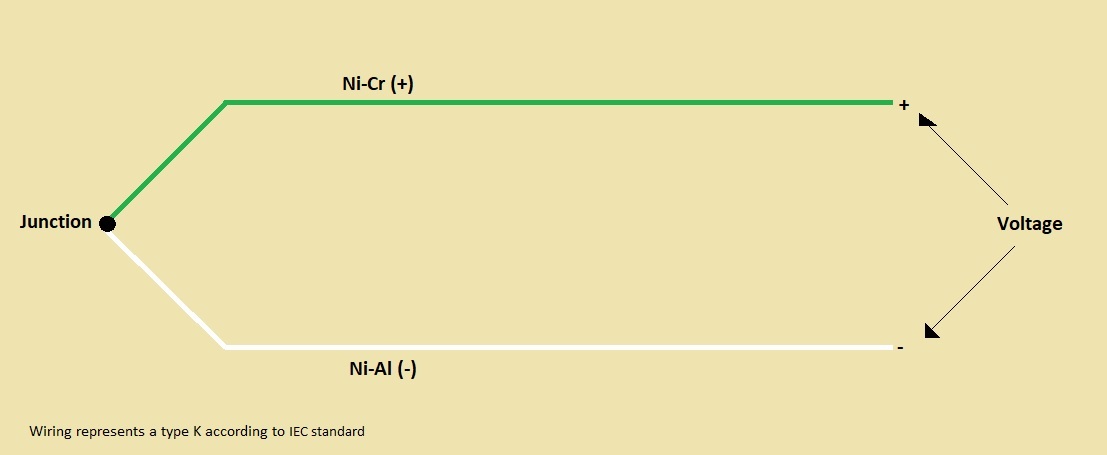
These sensors consist of two wires of dissimilar metals joined together at a single point or junction. As a result, the union between these two metals generates a voltage that is a function of temperature. Thermocouples operate on this principle called “Seebeck Effect”. While almost any pair of metals can be used to create a thermocouple, only a certain number of them are used because they produce predictable voltages and wide temperature gradients.
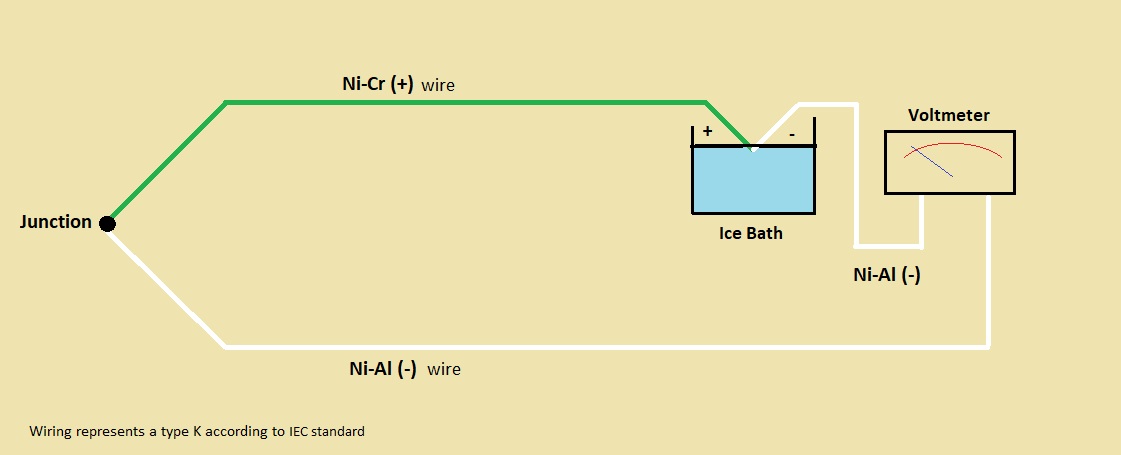
To know what the temperature is at the hot end, we will need to identify the voltage produced and the temperature at the other (cold) end. Unfortunately, it is not possible to connect a voltmeter to the thermocouple to measure this voltage because the multimeter connection is typically a different material than the thermocouple material. Therefore, we will be creating two new thermocouples in the multimeter connections. A technique known as Cold Junction Compensation was developed to solve this problem.
Cold Junction Compensation
Initially, the cold end was put in an ice bath; something that any laboratory could reproduce. Next, thermocouple voltage tables were developed based upon the cold junction end being in an ice bath. The voltage was recorded and looked up in the tables referenced to the ice bath (0°C) and the hot end temperature was derived.
Today, it is impractical to use the ice bath in industrial uses. There are two commonly used approaches:
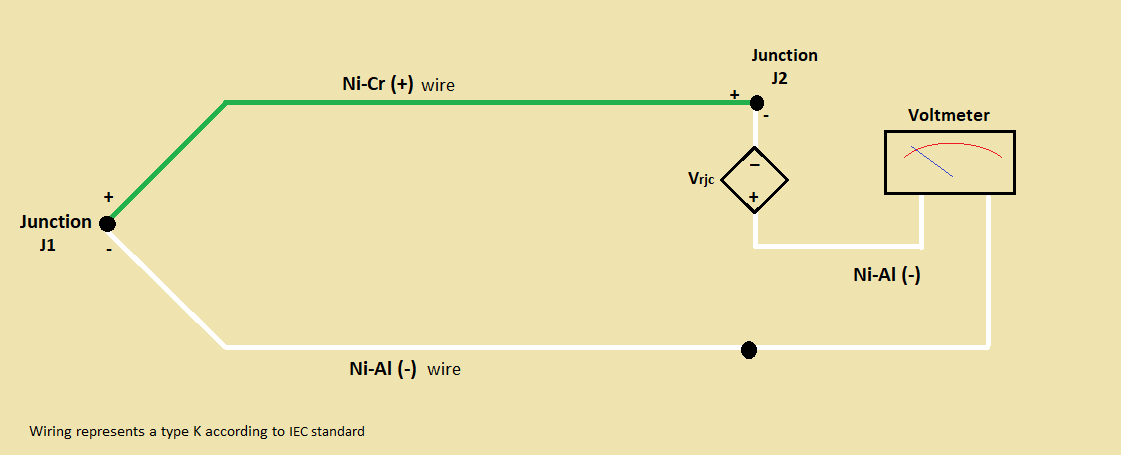
Connect a voltage source in opposite polarity to the J1 junction with a voltage magnitude equal to the voltage produced at the J2 junction as shown in the picture:
Then, this allows electronics to use the established thermoelectric voltage tables (or polynomials) to determine the temperature at the hot end. This approach makes two approximation errors, one for estimating the cold junction temperature, and one for approximating the effects on junction potential.
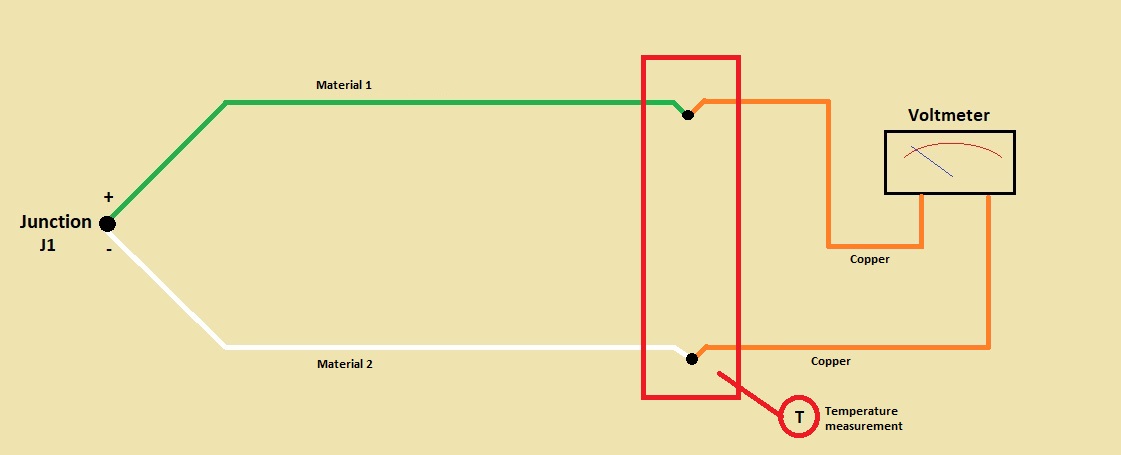
Independently measure the temperature of the cold junction. Measure the thermocouple potential and apply conversion curves to determine the temperature difference across the thermocouple. Then add the known cold junction temperature to the measured temperature difference to determine the absolute temperature measurement.
This approach uses one less estimate, but it still depends on accurate measurements of the cold junction temperature.
Thermocouples are differential temperature-measurement devices. When working with them, a reference point must be established. The main selection criteria for the appropriate cold-junction compensation device are accuracy, cost, linearity, and temperature range. Some platinum RTDs offer the best accuracy, but at higher cost. Thermistors are inexpensive and operate over a wide temperature range, but their lack of linearity can be problematic. Silicon temperature-sensing ICs operate over a narrow temperature range but offer reasonable accuracy, linearity, and low cost, thus making them a suitable choice for many thermocouple cold-junction compensation applications.
Via our partnership H&B Sensors, Fluidic can supply complete temperature instrumentation assemblies. Please take a look at our thermocouple range and accessories such as connection heads, thermowellsand transmitters. Our team is technically trained to help with any instrument selection.
For further information regarding thermocouple charts please check our post here.
Differential Pressure
One of the most common measurements taken by instrumentation is pressure, particularly differential pressure. So, what is differential pressure and how is it measured?
What is DifferentialPressure (DP)?
Differential pressure is, quite simply, the difference in pressure measured between two points. Filtration is a common application where pressure drop across a filter (i.e. the pressure difference between upstream and downstream of the filter) is indicative of filter condition. A blocked filter, or one nearing saturation, will cause a large pressure drop and require the associated pump/fan to work much harder. This is easily monitored by DP, allowing an economical filter change maintenance routine. Additionally, it can be noted that a very low differential pressure could identify a burst filter. (The Dwyer Photohelic A3000 Switchgauge and Dwyer Photohelic 3000MR Switchgauge both include a gauge measurement display and adjustable high and low DP switch outputs for such practice).
Other common applications include cleanroom monitoring (to ensure rooms are maintained at positive or vacuum pressure as required, often in a cascade environment). In hydrostatic level monitoring, we often use differential pressure to compensate for any inherent pressure in the tank. See the Honeywell STF800 SMARTLINE Hydrostatic Level Transmitters for more details of this application.
Particularly in air or gas applications, differential pressure can be very low – often measured in Pascals. One Pascal (1Pa) is the equivalent of 1/100,000 bar. It is essential to ensure that the correct type of differential pressure instrument is selected per application.
How do we select the correctdifferential pressure instrument?
This will depend on a number of factors, but the measurement principle remains similar regardless.
As mentioned earlier, differential pressure is measured between two points. This may be two pressurised areas or one pressurised area with the other open to atmosphere. The measurement will be taken through the instrument, be that a gauge, switch or transmitter.
In all DP instruments, each pressure input will feed either side of a measurement diaphragm. The diaphragm will flex in the direction of +ve differential pressure. The extent of this positive deflection will drive the measurement sensor (often a piezoelectric sensor, or in the case of the Dwyer Magnehelic Differential Pressure Gauge via a magnetically driven helix), to a conditioned output, trip or gauge display.
It can be seen that diaphragm material selection is extremely important. When selecting the type of instrument required it is essential to know the ballpark range of pressure the instrument will be dealing with, as well as the medium that it will encounter. Diaphragms come in various material types to handle the varying ranges of these requirements. The commonly specified 316SS diaphragm will not typically suit small, pascal measurements such as cleanroom or air HEPA filter monitoring applications. Our range of transmitters from Micatrone along with Dwyer’s previously mentioned Magnehelic and Photohelic options utilise large rubber diaphragms which are responsive to small pressure changes. Dwyer have recently released a new 0-30Pa range within the Magnehelic allowing higher accuracy than ever before in such applications.
Dwyer Magnehelic Product Overview Video
DP vs two separate pressure measurements?…
In theory, two separate pressure transmitters could be used to generate a DP measurement within the control system itself. For example, a liquid line may be running at 3bar. A filter with a normal operating pressure drop of 100mbar could be considered for change at, e.g. 200mbar (manufacturers will normally recommend specific values). It could be argued that a 0-5bar transmitter/gauge may be fitted either side of the filter. In clean conditions upstream will measure 3bar, downstream 2.9bar, giving a differential of expected 100mbar. HOWEVER, give consideration to the uncertainty of measurement of each device, which is typically taken as a percentage of full scale. For a +/- 1%fs instrument, a 0-5barg pressure transmitter will have an uncertainty of 50mbar. Doubling this (as there are two transmitters), the total DP measurement reading could be argued as 100mbar +/- 100mbar!! Using a differential pressure transmitter of range e.g. 0-500mbar DP and the same +/-1%fs, the same measurement would be 100mbar +/- 3mbar – a much more reasonable working tolerance.
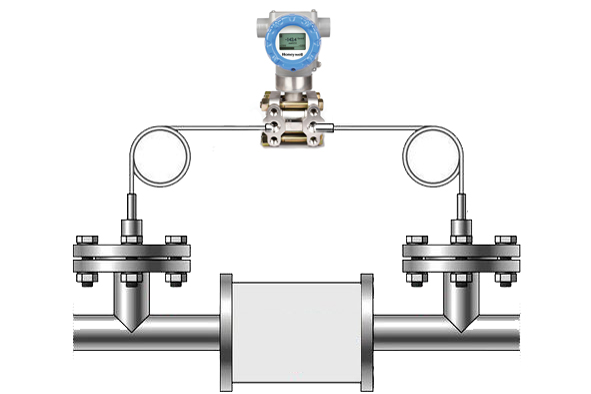
The very crude “knock up” schematic above shows how a Honeywell DP transmitter may be fitted across a liquid filter bank for DP measurement.
Many manufacturers offer “electronic DP” using two gauge pressure transmitters. There can be a lot of benefits in this design, but always give consideration to each specific application and the pressures etc under scrutiny. Fluidic have engineers on hand to help with instrument selection.
Please call either office for more information (Glasgow 0141 641 5920, Warrington 01925 572401)
Latest Response to COVID-19 outbreak
Fluidic are in full support of the most recent announcement made by the Prime Minister on the evening of 23/3/20. Our sales and accounts teams are all working from home and remain fully contactable via the usual office and email numbers. In support of essential industries (including power generation, hospitals, pharmaceutical, food production etc) only the very minimal staff required to complete essential orders and deliveries will attend our workplaces. This includes calibration, service and dispatch. Any team member attending the workplace (which is 2 maximum each site) will maintain the government specified distancing and will only be there as and when absolutely necessary.
In response to the delays that initially came through following the epidemic, we recently reviewed and increased our stock levels to support ongoing demand. Particularly in the case of products like the Dwyer Magnehelic and Micatrone MF-PFA both of these instruments are used in isolation pressurisation monitoring and were included in our recent stock boost. We have already seen orders for isolation booth monitoring this week. Wherever possible we are keen to play whatever small part we can in helping the essential services continue. (Our instrument supply to essential industry is far from limited to these instruments, merely an example that are currently in stock).
For any sales enquiries (for any application), or an accounts enquiry please contact our team working from home via the normal email and telephone numbers. Forthcoming months are going to be tough on everyone. We all must work together to maintain a strong economy for the times ahead. You can be sure that everyone at Fluidic will play our part.
Most importantly, we wish all of our customers and partners a safe and healthy time throughout this ordeal.
Contamination Expo, NEC Sep2019
Fluidic were pleased to join our partner, Status Instruments at last week’s Contamination Expo at the NEC, Birmingham. Our Dave Farman joined Status’ Lizzie and Lawrence for an interesting event, focusing on the Waste Water sector. Datasheets for our range of Status products can be found HERE.
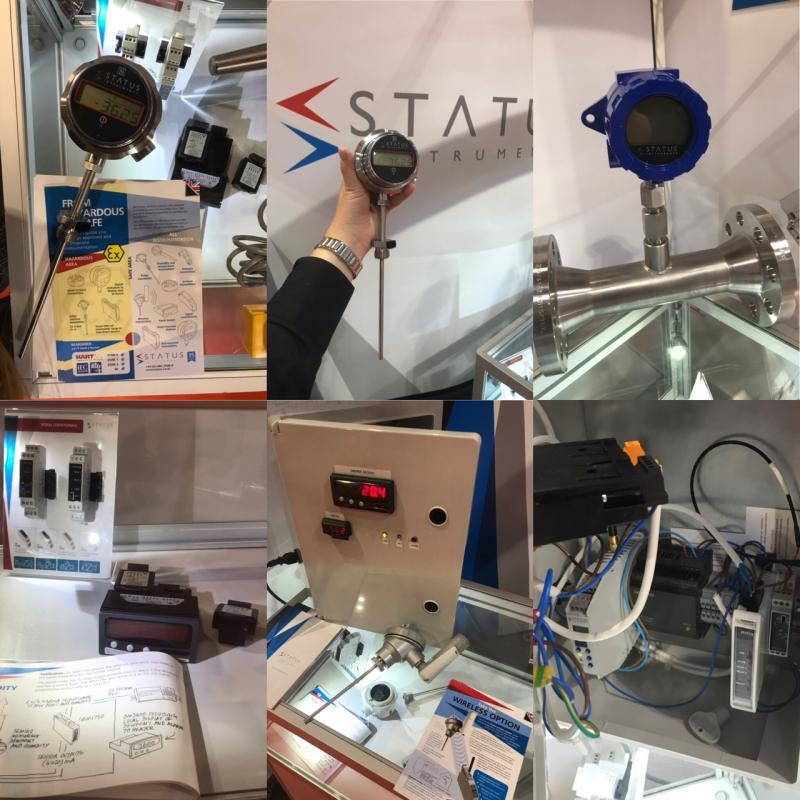
One product offering particular excitement, was Status’s brand new SEM320 Temperature Transmitter with in built head and display. This transmitter includes flagship electronics, including HART output, and was exclusively released at the show. Photo of the demo kit shown top right in the photo below.
This website uses cookies to improve your experience. We'll assume you're ok with this, but you can opt-out if you wish.AcceptRead More
Privacy & Cookies Policy
Privacy Overview
This website uses cookies to improve your experience while you navigate through the website. Out of these, the cookies that are categorized as necessary are stored on your browser as they are essential for the working of basic functionalities of the website. We also use third-party cookies that help us analyze and understand how you use this website. These cookies will be stored in your browser only with your consent. You also have the option to opt-out of these cookies. But opting out of some of these cookies may affect your browsing experience.
Necessary cookies are absolutely essential for the website to function properly. This category only includes cookies that ensures basic functionalities and security features of the website. These cookies do not store any personal information.
Any cookies that may not be particularly necessary for the website to function and is used specifically to collect user personal data via analytics, ads, other embedded contents are termed as non-necessary cookies. It is mandatory to procure user consent prior to running these cookies on your website.