
Fluidic have partnered Vaisala since our incorporation more than 30 years ago. Vaisala are an internationally recognised manufacturer of high quality instrumentation, with a specialism in moisture measurement. One question that we are asked on a regular basis is – do I need a “humidity transmitter, or do I need to measure dewpoint?” Both are similar, and in fact many of our Vaisala transmitters give both outputs via calculation, but it is important to select the correct primary measurement for your application. The best way to start this explanation, is perhaps to understand the difference in both types of measurement…
Humidity measurement
Humidity, or more specifically Relative Humidity, is defined as the amount of moisture in the air relative to the amount of moisture the air can hold at that temperature.
In most indoor environments we try to maintain RH levels at around 50%. As RH is affected by temperature, this would be temperature dependent – but of course, for comfort control it is necessary to maintain ambient temperatures to approx 20°C too.
Dewpoint
Dewpoint is not affected by the surrounding temperature. In fact, dewpoint IS a temperature measurement. It is the temperature to which ambient must drop to in order for saturation (or “dew”) to form. In other words, it is the temperature at which RH will be 100%. Dewpoint is always less than the surrounding temperature, but the closer these temperatures are together then the “wetter” the environment will be.
A useful tool is the Vaisala humidity calculator. This on-line tool, calculates one parameter from another (plus several more measurements that are not covered by this article). Download for free at the following link (registration required) https://www.vaisala.com/en/calculators/humidity-calculator .
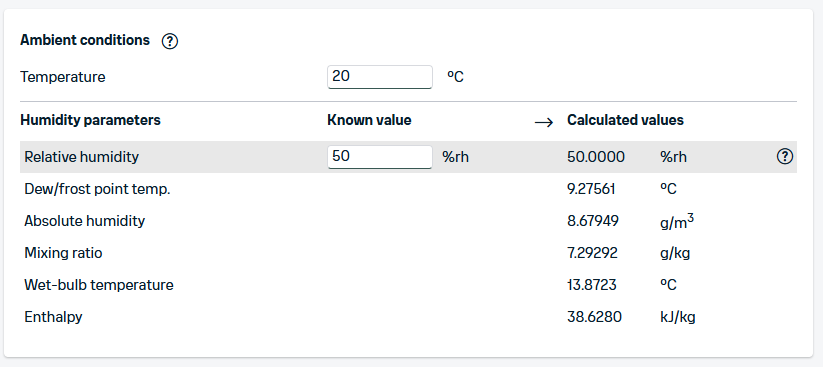
The above snip shows that, at 20degC and 50% RH, dewpoint is approximately 9.3degC.
Lets consider the above environment. Something happens, temperature remains constant, but humidity spikes but an additional 30%. What happens to dewpoint?
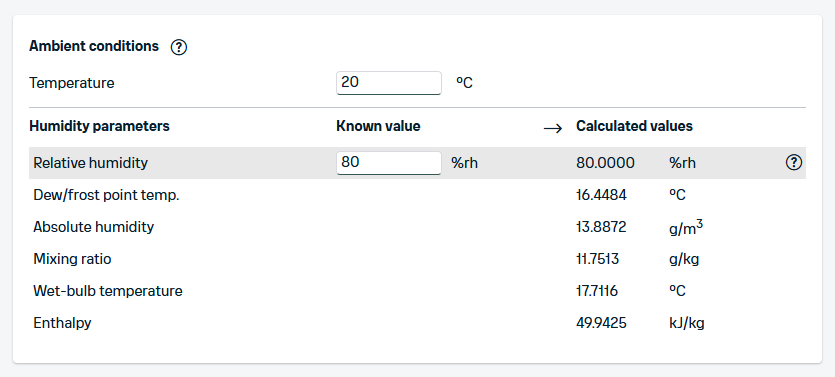
Of course, dewpoint rises – the environment is wetter, so dewpoint temperature and ambient temperature will get closer together. However, a 30% spike in RH relates to only a 7deg change in dewpoint.
In ambient conditions, it is more common to measure Relative Humidity and Temperature (commonly referred to as RH&T). The above conditions are exaggerated – of course a 7 deg change in dewpoint (Td) is quite measurable – but there would be no real benefit in opting for dewpoint as the primary measurement (which is typically a more expensive measurement).
Lets consider, however, a very dry environment such as a compressed airline with dewpoint at -40degC and ambient still at 20degC.
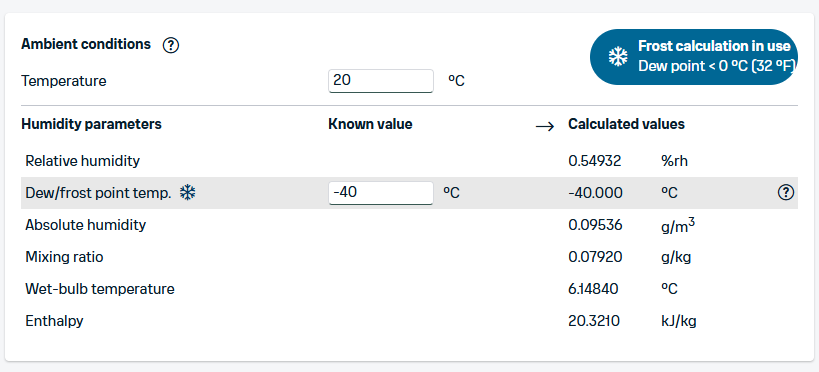
RH levels are only 0.54%. This is very low, and quite possibly below the calibrated range of the RH device. More importantly, if – even a high accuracy – RH transmitter with accuracy approx ±1%RH took the primary measurement, what would happen if the RH output +1.5% reading (ie still within accuracy)? As below the effect on dewpoint is massive – changing measurement of Td by 10°C.
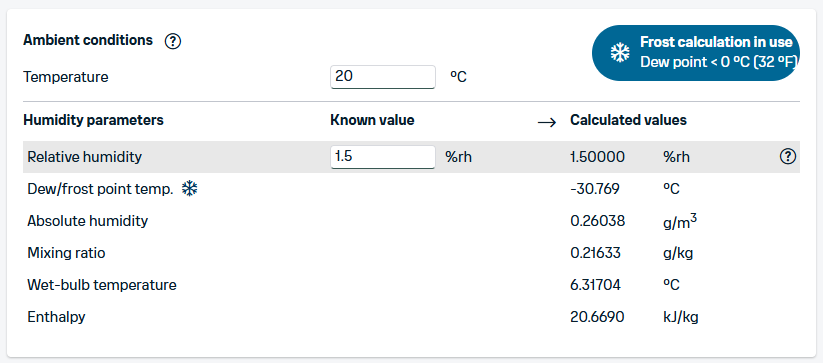
In very dry applications, it is recommended to use dewpoint dedicated devices, rather than RH devices with a calculated Td output.
Fluidic have partnered Vaisala for more than 30 years. Vaisala dewpoint probes are available down to -80°C measurements. Of course, there are a number of factors to consider for your measurement application, and this short article only scratches the surface. Please speak to one of our instrument engineers for help with product selection for your specific application.