AQE Exhibition 2015

AQE - Air Quality and Emissions Exhibition 2016

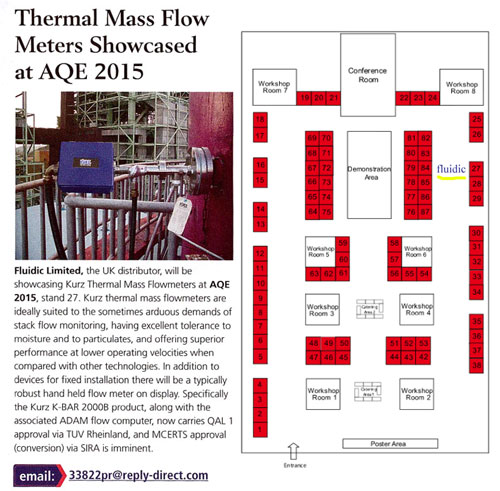
Fluidic are pleased to hold a stand at the upcoming AQE – Air Quality and Emissions – exhibition on April 22nd and 23rd 2015.  This year we will be exhibiting our range of thermal mass flowmeters from Kurz, more details above taken from a recent magazine article.  Our Howard Feather and David Cairney will be on stand 27 (highlighted in the floorplan above). Please drop by to discuss your AQE application.

LEV Systems

Reliable airflow measurements in LEV systems

With advances in employee safety, energy efficient plant and an emphasis on continuously improving product quality, industry is beginning to recognise the benefits of an efficient Local Exhaust Ventilation (LEV) system. LEV systems typically run at relatively low air velocities. Obtaining a true measurement of this extraction rate can better help balance the cost of overworking power-hungry extraction systems against dangerously under extracting contaminates and health-adverse fumes.

Traditional pitot tube measurements offer a means of calculating air velocity in a duct by means of pressure measurement. In the duct a static pressure is present along with a pressure caused by the air velocity itself.

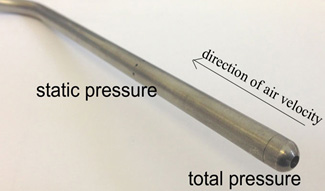
The illustration shown below shows the measurement end of a traditional, single point pitot tube. Within the tube itself, two channels are passed up towards the differential pressure instrument.

Single Point Pitot Tube


HI side of the instrument collects TOTAL PRESSURE (i.e. velocity pressure + static)
LOW side of the instrument collects only static pressure (perpendicular to the direction of air velocity).


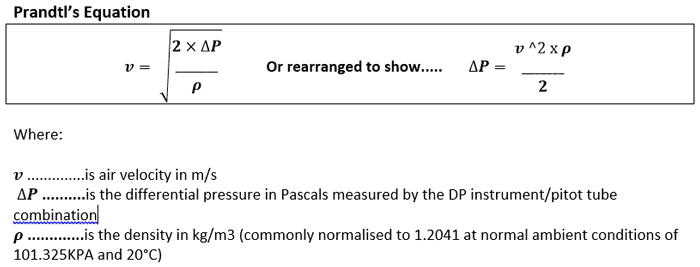
The differential pressure instrument then provides the pressure caused by only the velocity itself.  Many differential pressure instruments include a “Square Root Extraction” function to calculate the velocity itself (and linearise the 4-20mA / 0-10V output in terms of a transmitter)…


Single Point Pitot Tube


Due to the very light density of air (1.2041) it is evident that low air velocity will produce low differential pressure measurement.   For example, using the equation above, even a relatively ‘strong’ LEV velocity of 3 m/s would only provide a differential pressure of around 5.4 Pa – barely measureable with most instrument technologies.


The solution?   There are a couple, depending on the application….

Thermal “hot wire” technology employs a technique of 2 high precision temperature elements (commonly RTDs). One element measures the temperature of the media itself and the other is heated to a set temperature above that of this reference measurement. As the air velocity increased (or reduces) the heated element cools proportionally. This cooling effect requires more (or less) power to maintain the set constant temperature differential. This, in turn, is proportionally conditioned by the transmitter to provide a 4-20mA / 0-10V output. Instruments with “CTA” Thermal Technology (see https://fluidic-ltd.co.uk/news/thermal-mass-flowmeters/ for information specifically on CTA technology) offer a very responsive and reliable measurement even at low air velocity (a typical sensor from Schmidt Technologies can offer its full analogue output over a range as low as 0…1m/s).


Alternatively, Micatrone manufacture a unique pitot tube sensor which amplifies the differential pressure produced by a value of approx 2.2. In the previous calculation of 3m/s this would lead to a differential pressure measurement of around 12Pa – around ¼ scale over the range of the recommended accompanying “Micaflex” 0-50Pa transmitter, getting closer to a workable solution.


So far, we have discussed air velocity measurement, i.e. in m/s. This is because traditional pitot tube and thermal technologies offer a single point measurement in the flow stream. In order to calculate this air velocity as a volumetric air flow, and understand the efficiency of the LEV system itself, it is important that air flow has a known and stable profile. Measurement points should be taken on a long straight section of the duct and “traversed”. That is to say that measurements should be taken at different insertion lengths throughout the duct, to fully understand the flow profile, and then averaged to calculate the true volumetric airflow (remember that even in a stable, laminar flow profile, the velocity may still be around 1.4x faster at the centre of the flow stream due to drag caused by the duct wall). The Micatrone pitot tube mentioned above is of a ‘self-averaging’ design, having several total pressure measurement points across its length. When twinned with the recommended Micaflex transmitter, the duct size may be input to provide a display and 4-20mA / 0-10V output linearised for volumetric airflow measurement.


Download This article was published in The Cleanroom Monitor magazine from S2C2 Issue 66 (Autumn 2014).


For more information on the topic of reliable airflow measurement in LEV systems, including details on the instruments discussed, please contact Fluidic on 0141 641 5920 (Glasgow) or 01925 572401 (Warrington).

Our Community

Our Community - Youth Employment in Lanarkshire

In November 2014, Pamela Nash, the local MP for Airdrie and Shotts launched “Our Community”.  This is a new initiative to help tackle youth employment issues in the local Lanarkshire area. This initiative mirrors a recent highly successful campaign implemented in Glasgow by the local MP, Frank Roy.  Fluidic participated in the initial event and were asked to speak in support of the initiative at a recent business breakfast held at the Eurocentral Industrial area.


Wireless Instruments

With advances in mobile communication, wireless technology is becoming more accepted in everyday life.  This has not passed by the instrumentation world, but what is a wireless instrument network and how does it operate?…


Common wireless instrument networks include:


Point to Point wireless is a fairly simple idea.  The Hanwell system offered by Fluidic utilises a 434MHz frequency to communicate information between the transmitter and receiver.  The transmitter may include a sensor (e.g. Relative Humdity, Temperature etc) or may simply take a basic analogue input from an existing transmitter.  The information is encoded for security and sent wirelessly to its receiver.  The receiver decodes this data, which is typically displayed (and logged) on a local laptop or PC.  Due to the relatively “slow” frequency of this technology, information is limited but can travel far.  That is to say only the process variable (the “4-20mA information”) is transferred, which can travel upto 3km in an ideal, clear line-of-sight installation.  Signal repeaters may be used to extend the range where necessary. The information is transferred in frequent intervals, typically every few minutes.  This leans the point-to-point wireless technology Fluidic offers towards facility monitoring applications.  Warehouse monitoring and cleanroom / pharmaceutical lab monitoring are typical applications with pre-existing install bases.


As Honeywell Field Product partners, Fluidic also offer Wireless Mesh Networks for more industrial applications.  Here a Field Device Access Point (FDAP) is used as a central receiver/transmitter to distribute information throughout the network.  In addition, the wireless transmitter itself may be used as part of the information distribution path, if user-enabled.  The FDAP is a dedicated distribution point, generally powered locally.  This allows very fast transfer of data every second.  For this reason, ISA100 wireless networks are unique to encroaching process control conditions rather than being limited to simple monitoring applications.


Using the transmitters as a secondary route will impose on transmitter battery life and transfer speed, but does add the option of redundancy in case of an FDAP outage.  Where the transmitter is not selected to be used as a distribution point, battery life is upto 10 years.  FDAPs themselves can be doubled up for redundancy, ensuring reliability.   This type of wireless mesh network complies to the ISA100 system running on 2.4GHz frequency.  This relatively fast transfer allows much more information to be sent, including process variable and diagnostics.  Coverage in an ideal install will be limited to around 300m between “hops”, of course as part of a “mesh network” several hops would offer very reasonable coverage.


All information from the ISA100 mesh network is eventually passed back to the Wireless Device Manager (WDM).  Information is gathered locally and can be incorporated into the user’s Distributed Control System (DCS) where desired.  The WDM offers a graphical interface for the instrument tech.  Image files (e.g. of P&ID drawings) can be used as the GUI backdrop onto which the user may position the mesh network arrangement and  instrument locations throughout the plant.  Again, in critical applications, 2x WDMS may be installed to offer redundancy within the system.


For more information on wireless instrumentation, please call your local Fluidic office. To receive more technical application notes like this please click the subscribe link below.

 

Subscribe to our Newsletter

Thermal Flowmeters

Thermal mass flowmeters can offer a reliable, responsive and accurate method of air and gas flow measurement over wide operating range.  They create negligible pressure drop and have no moving parts prone to failure and wear.  Additionally, due to the principles involved, thermal mass flowmeters are self compensating for pressure and temperature.


The basic technology of a thermal mass flowmeter involves 2x temperature sensing elements (typically RTDs)….

– 1x measures the gas temperature
– 1x heated element


In a traditional Constant Power Thermal Anemometer (CPA) constant power is applied to the heated element.  Due to thermal conductivity, as flow rate increases heat is drawn away from the heated sensor.  This cools the heated element, reducing the temperature differential between each RTD element.  The temperature differential measured by the CPA thermal mass flowmeter is therefore indicative of flow rate.  The inbuilt electronics will condition the signal appropriately.


In a Constant Temperature Thermal Anemometer  (CTA) the heated element is instead heated to a constant temperature differential above the gas process temperature.  In CTA technology therefore the changing power required to maintain this temperature differential is indicative of flow rate.  Again, inbuilt electronics will condition the signal appropriately.


CPA vs CTA Thermal Mass Flowmeters

Traditional CPA thermal mass flowmeters have been assessed as problematic at extremities of their measurement range:
Zero reading is unreliable.  Where no flow occurs the temperature difference is very high.  As there is no flow to “draw” the heat away, convection can heat the gas measurement element.
At the high end of the range, the temperature difference is very small.  This itself leads to issues with resolution and uncertanty of the RTD element, where even a small temperature uncertainty is exaggerated into a large flow change.


In a CTA thermal aneometer, the temperature difference is constant.  The ‘ideal’ temperature difference maybe researched by the manufacturer and selected to create the least uncertainty across the entire measurement spectrum.


Industry

Fluidic are the UK distribution point for all Kurz CTA Thermal Mass Flowmeters.  Probably the most common application would be burner control, common in power stations, steelworks, glassworks etc…  A well controlled burner system is imperative to ensure a clean and efficient energy control system.  Traditional DP methods of flow monitoring (annubar/pitot tube) do not lend themselves well to a dirty process where small orifices in the measurement system can clog.

Due to the accurate, responsive and reliable range nature of Kurz Thermal Mass Flowmeters we also have supplied many to ventillation applications in safety critical systems.  In the UK nuclear industry, Kurz (via Fluidic) is the preferred option and have been EMPHASIS assessed in accordance with this.


Application notes

Thermal Mass Flowmeters are (as the title suggests!) primarily instruments to measure mass flow.  The number of molecules passing over the elements – along with the properties of these molecules – are what determines the cooling effect and flowrate measurement. Due to this, readings are self compensating for pressure (more pressure = more molecules). At time of order it is imperative to indicate the process gas in the application.  Due to thermal properties, some gases could effect reading as much as 10x that of, say, air.  Via Kurz Instruments, Fluidic are able to supply the thermal mass flowmeter calibrated specifically for your application.


Kurz 454FTB Insertion CTA thermal mass flowmeter

Kurz 504FTB inline CTA thermal mass flowmeter

Kurz 534FTB inline CTA thermal mass flowmeter (with flow straightener)


For more information on wireless instrumentation, please call your local Fluidic office. To receive more technical application notes like this please click the subscribe link below.
 

Subscribe to our Newsletter

Wake Frequency

The purpose of a thermowell is to allow removal of the temperature sensing element without disrupting the process.  With the temperature sensing element installed however, it is important that process temperature is transferred through the thermowell efficiently and with minimal effect on response time.


Thermowell Wake Frequency calculations are generally conducted prior to thermowell manufacture.  They ensure that the thermowell design is robust enough to cope with varying stresses and strains produced by the process media.  Fluidic are able to provide Wake Frequency Calculations where the following process data is available:


  1. Pressure
  2. Temperature
  3. Velocity (or flowrate with linesize)
  4. Viscosity
  5. Density


Any thermowell failure will occur at the highest stress point, ie between the flange/shaft join.  With the exception of the use of velocity collars (which cause their own problems, and are not recommended within current ASME PTC 19.3 TW-2010 standards), this has traditionally meant shortening of, or bulking up the thickness of, the thermowell.  Both of these techniques will significantly increase response time and are detrimental to temperature measurement performance.


In applications where the Thermowell Wake frequency calculation fails due to Strouhal frequency (such as in the example calculation shown below) Fluidic’s partner, Okazaki, have developed the VortexWell thermowell.  This helical design sheds vortexes normally caused by the thermowell itself and therefore cancels out the resonance failure issue apparent in traditional thermowell design.  Using an Okazaki Vortexwell in the example shown would therefore be deemed a technically sound install for this application.


 Download   Sample Thermowell Wake Frequency Calculation


For more information on wireless instrumentation, please call your local Fluidic office. To receive more technical application notes like this please click the subscribe link below.
 

Subscribe to our Newsletter

Wet Gas Flowmeter

Fluidic represent Kurz Instruments, suppliers of high accuracy thermal mass flow meters. Kurz have developed a wet gas flowmeter for accurately measuring mass flow in biogas, condensing gas and wet-stack environments.


In condensing gas environments such as landfill or digester gas measurement, moisture can cause problems with thermal mass flowmeters. Water droplets forming on the sensors heated element result in an increase in energy to the element.  This causes the meter to report much higher flowrates than are actually occurring. Large water droplets can cause significant flow spikes for up to 30 minutes.


To overcome this problem, Kurz have developed the 454FTB-WGF, wet gas flowmeter. Kurz have adapted their successful 454FTB design by heating the heated sensor to 300°C above the ambient temperature sensor. As the water droplets impact the heated sensor they immediately vaporize and create a layer, caused by the Leidenfrost effect, which diverts the remaining water around the sensor leaving it unaffected by the moisture in the gas.


The Kurz 454FTB-WGF allows for reliable and accurate mass flow measurement in wet gas applications.


Ceramic Manufacture

Fluidic’s partner, Vaisala, have helped Koramic Pottelberg – a Belgian ceramic tile manufacturer with their drying process.  At the start of manufacture, ceramic tiles must be kept at a high humidity level and dried slowly to prevent cracking and reduced product quality.  With traditional RH&T (Relative Humidity and Temperature) instrumentation, moisture saturation around the sensor will cause issues and reduced response.  In the case of Koramic Pottelberg this meant incorrect operation of driers, and reduced efficiency of process.

With the Vaisala HMT337 relative humidity and temperature transmitter supplied with heated sensor, the customer was able to closely monitor high humidites without affecting response time nor instrument accuracy.  A second temperature probe included with the instrument compensates for any temperature affect caused by the heater.  In turn the customer was able to significantly improve product quality and manufacture efficiency.


Download  Ceramic manufacture, drier application note in full.


Portable RH&T Meters

Vaisala HM40 Portable Relative Humidity and Temperature instrumentation offers a low cost solution to spot check RH&T applications. Available with fixed probe and probe on a 1.2m remote ‘curly cable’, the Vaisala HM40 comes fitted with the reliable HUMICAP sensor from Vaisala ensuring a stable, responsive sensor technology.  Typical specifications as follows:


Vaisala HM40 Portable RH&T instrumentation Product Page


Plastics Drying

Dew Point Control Ensures Product Quality and Energy Savings in Plastics Drying

Excess moisture in plastics decreases product strength and causes a poor surface finish. On the other hand, excessive polymer drying wastes energy and lowers productivity as material delay in the dryer is needlessly prolonged. Dryer dew point controls help to achieve good product quality with minimal production costs.


As Vaisala partners for Scotland and North England, Fluidic offer a range of reliable dewpoint measurement instrumentation.  Incorporating the Vaisala DRYCAP sensor, this ensures a reliable and stable dedicated dewpoint measurement for dry applications.

Download Read the complete application note to learn how to optimize desiccant dryer operation using dew point measurement.